



















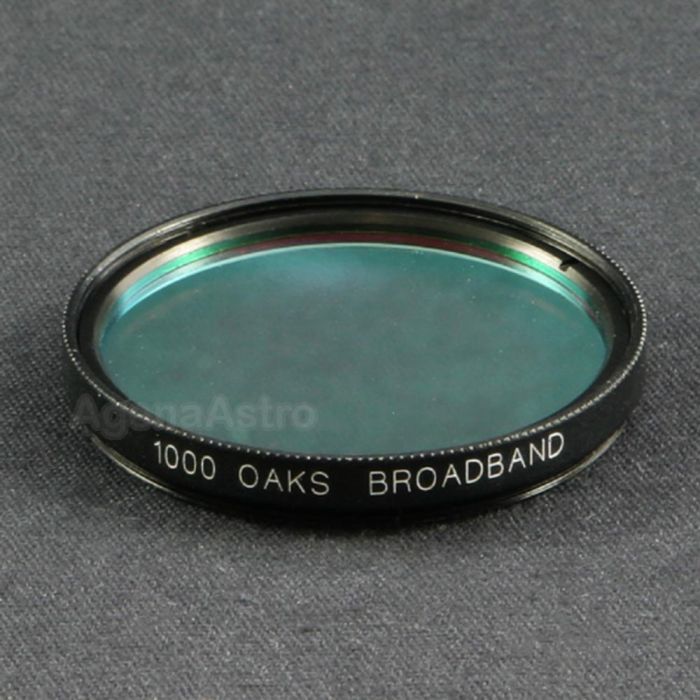
Thousand Oaks Optical Broadband Light Pollution Reduction Filter - 2"
- This item is out of stock.
- We have no ETA from the manufacturer at this time.
- Sign up for back-in-stock alerts to be notified when this item becomes available.
Stock count is accurate & shown in real time.
- This item is out of stock.
- Sign up for back-in-stock alerts to be notified when this item becomes available.
- This item is out of stock.
- We have no ETA from the manufacturer at this time.
- Sign up for back-in-stock alerts to be notified when this item becomes available.
Lower 48 States:
Orders over $50 ship free within the Lower 48 using a carrier and service we select based on your items and delivery location. Faster shipping options may be available at checkout.
U.S. Outside the Lower 48 (AK, HI, PR):
Free shipping on orders over $50 applies to many—but not all—items. Add items to your cart and enter your ZIP code to see available shipping options and any costs.
International Orders:
Free shipping does not apply to international orders. You’ll see available shipping options and costs during checkout. Some items can’t be shipped internationally due to size or manufacturer restrictions. Duties, taxes, brokerage fees, and tariffs are not included and are the customer’s responsibility.
Please note: Thousand Oaks' filters often have tiny dots, sleeks, and/or light scratches on the glass surface. These flaws will have no impact on optical performance and the spectral characteristics of the filter are not compromised. These are all brand new as received from the manufacturer and this is just how they come.
- Blocks most man-made light pollution (sky glow) from common sources such as mercury vapor and sodium vapor lighting
- Improves the visibility and contrast of emission nebulae and other similar deep sky objects
- Can improve visibility and contrast of some reflection nebulae and larger, diffuse galaxies
Broadband "Light-pollution Reduction" (LPR) filters are designed to improve the visibility of deep sky objects by blocking out the mercury vapor, sodium vapor, and other such emission lines from man-made or natural sources which contribute to light pollution. In turn, these filters allow a broad range of more useful wavelengths to pass to the eye or imaging sensor. By selectively screening out of some of the background sky glow, the contrast is increased and allows deep sky objects to stand out against the background.
Broad-band filters don’t eliminate the effects of light pollution or make the objects brighter, but they can improve the visibility of many deep-sky objects. Emission nebulae are the most improved, but these filters can also give a slight contrast boost to reflection nebulae and a few of the larger and more diffuse galaxies. Large versions of these broadband filters that can fit over DSLR lenses can improve imaging of wide fields when sky glow is present.
Broadband filters can offer a noticeable boost in contrast and visibility of the fainter outer detail for objects like the Orion nebula (M42), the Lagoon nebula (M8), the Trifid nebula (M20), and others. The improvement isn’t as noticeable on star clusters or small galaxies.
Since some light is blocked by the filters, objects may look fainter from a dark sky site when using a broad-band filter than without one. Severe levels of light pollution can be too much for the broad-band filters to handle effectively, so observing from a dark site is preferred in these cases.
Other Information
- Country of Manufacture: United States
Broadband "Light-pollution Reduction" (LPR) filters are designed to improve the visibility of deep sky objects by blocking out the mercury vapor, sodium vapor, and other such emission lines from man-made or natural sources which contribute to light pollution. In turn, these filters allow a broad range of more useful wavelengths to pass to the eye or imaging sensor. By selectively screening out of some of the background sky glow, the contrast is increased and allows deep sky objects to stand out against the background.
Broad-band filters don’t eliminate the effects of light pollution or make the objects brighter, but they can improve the visibility of many deep-sky objects. Emission nebulae are the most improved, but these filters can also give a slight contrast boost to reflection nebulae and a few of the larger and more diffuse galaxies. Large versions of these broadband filters that can fit over DSLR lenses can improve imaging of wide fields when sky glow is present.
Broadband filters can offer a noticeable boost in contrast and visibility of the fainter outer detail for objects like the Orion nebula (M42), the Lagoon nebula (M8), the Trifid nebula (M20), and others. The improvement isn’t as noticeable on star clusters or small galaxies.
Since some light is blocked by the filters, objects may look fainter from a dark sky site when using a broad-band filter than without one. Severe levels of light pollution can be too much for the broad-band filters to handle effectively, so observing from a dark site is preferred in these cases.
Please note: Thousand Oaks' filters often have tiny dots, sleeks, and/or light scratches on the glass surface. These flaws will have no impact on optical performance and the spectral characteristics of the filter are not compromised. These are all brand new as received from the manufacturer and this is just how they come.
- Blocks most man-made light pollution (sky glow) from common sources such as mercury vapor and sodium vapor lighting
- Improves the visibility and contrast of emission nebulae and other similar deep sky objects
- Can improve visibility and contrast of some reflection nebulae and larger, diffuse galaxies
Broadband "Light-pollution Reduction" (LPR) filters are designed to improve the visibility of deep sky objects by blocking out the mercury vapor, sodium vapor, and other such emission lines from man-made or natural sources which contribute to light pollution. In turn, these filters allow a broad range of more useful wavelengths to pass to the eye or imaging sensor. By selectively screening out of some of the background sky glow, the contrast is increased and allows deep sky objects to stand out against the background.
Broad-band filters don’t eliminate the effects of light pollution or make the objects brighter, but they can improve the visibility of many deep-sky objects. Emission nebulae are the most improved, but these filters can also give a slight contrast boost to reflection nebulae and a few of the larger and more diffuse galaxies. Large versions of these broadband filters that can fit over DSLR lenses can improve imaging of wide fields when sky glow is present.
Broadband filters can offer a noticeable boost in contrast and visibility of the fainter outer detail for objects like the Orion nebula (M42), the Lagoon nebula (M8), the Trifid nebula (M20), and others. The improvement isn’t as noticeable on star clusters or small galaxies.
Since some light is blocked by the filters, objects may look fainter from a dark sky site when using a broad-band filter than without one. Severe levels of light pollution can be too much for the broad-band filters to handle effectively, so observing from a dark site is preferred in these cases.
Other Information
- Country of Manufacture: United States
| Free Shipping Graphic | Free US Shipping |
|---|---|
| Hide Found a better Shipped Price on Frontend? | No |