



















QHY 5-III 462C Color Astronomy Camera with USB 3.0
Stock count is accurate & shown in real time.
- This item is out of stock.
- Sign up for back-in-stock alerts to be notified when this item becomes available.
- This item is out of stock.
- We have no ETA from the manufacturer at this time.
- Sign up for back-in-stock alerts to be notified when this item becomes available.
Lower 48 States:
Orders over $50 ship free within the Lower 48 using a carrier and service we select based on your items and delivery location. Faster shipping options may be available at checkout.
U.S. Outside the Lower 48 (AK, HI, PR):
Free shipping on orders over $50 applies to many—but not all—items. Add items to your cart and enter your ZIP code to see available shipping options and any costs.
International Orders:
Free shipping does not apply to international orders. You’ll see available shipping options and costs during checkout. Some items can’t be shipped internationally due to size or manufacturer restrictions. Duties, taxes, brokerage fees, and tariffs are not included and are the customer’s responsibility.
The new QHY5III462C camera uses the latest (6th Generation) 2.1 megapixel IMX462 STARVIS CMOS sensor from Sony. The pixel size is 2.9u making it the same size and resolution as the sensor used in the QHY5III290 camera that has been so successfully used for planetary imaging by some of the best planetary imagers in the world. Like others in the series, the QHY5III462C is USB 3.0 powered and controlled. No additional power is required.
The IMX462 sensor is back-illuminated and has new features that give it two significant advantages over other planetary cameras: First, the IMX462 sensor has sHGC for extremely low read noise (less than one electron) at high gain. This is ideal for stacking hundreds or thousands of short planetary images. Second, it is exceptionally sensitive in the NIR. In this generation of sensor, the photodiode portion of the pixel well is deepened, allowing photons of longer wavelength to penetrate deeper into the substrate and thereby dramatically increases the sensor's sensitivity to red light and near infrared light (NIR). The RGB filters over the pixels become transparent at NIR wavelengths, so the sensor displays almost equal peak sensitivity to NIR light as it does to light in the visible spectrum.
The peak QE in the NIR around 800nm is as high or higher as the peak QE in the visible wavelengths. For planetary imagers using a methane filter that passes light around 880nm this is welcome news.
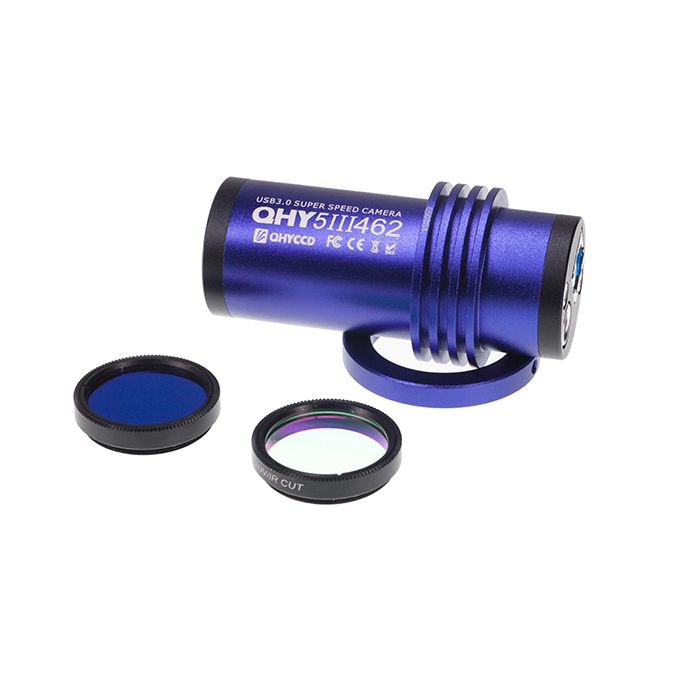
The QHY5III462C camera will include two 1.25" screw-in filters, a UV/IR cut filter to isolate the visible wavelengths for normal RGB imaging and an IR850 filter that will cut the visible wavelengths but pass wavelengths above 850nm. Together, this yields a camera that can image in (a) visible light only, or (b) NIR light only, or (c) combined visible and NIR. Passing all the light, visible and NIR, will produce a very sensitive luminance frame (when shot through a reflector or other scope capable of focusing visible and NiR together) for producing LRGB color images.
Specifications:
- Model: QHY5III462C (Color and Enhanced Near Infrared)
- CMOS Sensor: SONY IMX462 CMOS
- Pixel Size: 2.9um x 2.9um
- Effective Pixel Area: 1920 x 1080
- Effective Pixels: 2 Megapixels
- Fullwell: 12000e-
- Readout Noise: 0.5e-
- AD Sample Depth: 12-bit (output as 16-bit and 8-bit)
- Sensor Size: Typical 1/2.8 inch
- Full Frame Rate: Full Resolution 135 FPS@8-bits (USB3.0 Port)
- ROI Frame Rate : Higher rates at selected fields of interest (Supports any region ROI)
- Exposure Time Range: 7us-900sec
- Shutter Type: Electronic Rolling Shutter
- Computer Interface: USB3.0
- Guide Port: Yes
- Telescope Interface: 1.25-inch
- Optical Window(s): Changeable 1.25-inch filter as optical window
- Filters Included: 1.25-inch UV/IR cut filter and 1.25-inch IR850 filter
- Weight: 88g
What's in the Box:
- QHY5III462C Camera
- 1.25" UV/IR Filter
- 1.25" IR850 Filter
- USB3.0 Cable
- Guiding Cable
- Focus Locking Ring
Other Information
- Country of Manufacture: China
The new QHY5III462C camera uses the latest (6th Generation) 2.1 megapixel IMX462 STARVIS CMOS sensor from Sony. The pixel size is 2.9u making it the same size and resolution as the sensor used in the QHY5III290 camera that has been so successfully used for planetary imaging by some of the best planetary imagers in the world. Like others in the series, the QHY5III462C is USB 3.0 powered and controlled. No additional power is required.
The IMX462 sensor is back-illuminated and has new features that give it two significant advantages over other planetary cameras: First, the IMX462 sensor has sHGC for extremely low read noise (less than one electron) at high gain. This is ideal for stacking hundreds or thousands of short planetary images. Second, it is exceptionally sensitive in the NIR. In this generation of sensor, the photodiode portion of the pixel well is deepened, allowing photons of longer wavelength to penetrate deeper into the substrate and thereby dramatically increases the sensor's sensitivity to red light and near infrared light (NIR). The RGB filters over the pixels become transparent at NIR wavelengths, so the sensor displays almost equal peak sensitivity to NIR light as it does to light in the visible spectrum.
The peak QE in the NIR around 800nm is as high or higher as the peak QE in the visible wavelengths. For planetary imagers using a methane filter that passes light around 880nm this is welcome news.
The QHY5III462C camera will include two 1.25" screw-in filters, a UV/IR cut filter to isolate the visible wavelengths for normal RGB imaging and an IR850 filter that will cut the visible wavelengths but pass wavelengths above 850nm. Together, this yields a camera that can image in (a) visible light only, or (b) NIR light only, or (c) combined visible and NIR. Passing all the light, visible and NIR, will produce a very sensitive luminance frame (when shot through a reflector or other scope capable of focusing visible and NiR together) for producing LRGB color images.
Specifications:
- Model: QHY5III462C (Color and Enhanced Near Infrared)
- CMOS Sensor: SONY IMX462 CMOS
- Pixel Size: 2.9um x 2.9um
- Effective Pixel Area: 1920 x 1080
- Effective Pixels: 2 Megapixels
- Fullwell: 12000e-
- Readout Noise: 0.5e-
- AD Sample Depth: 12-bit (output as 16-bit and 8-bit)
- Sensor Size: Typical 1/2.8 inch
- Full Frame Rate: Full Resolution 135 FPS@8-bits (USB3.0 Port)
- ROI Frame Rate : Higher rates at selected fields of interest (Supports any region ROI)
- Exposure Time Range: 7us-900sec
- Shutter Type: Electronic Rolling Shutter
- Computer Interface: USB3.0
- Guide Port: Yes
- Telescope Interface: 1.25-inch
- Optical Window(s): Changeable 1.25-inch filter as optical window
- Filters Included: 1.25-inch UV/IR cut filter and 1.25-inch IR850 filter
- Weight: 88g
What's in the Box:
- QHY5III462C Camera
- 1.25" UV/IR Filter
- 1.25" IR850 Filter
- USB3.0 Cable
- Guiding Cable
- Focus Locking Ring

The new QHY5III462C camera uses the latest (6th Generation) 2.1 megapixel IMX462 STARVIS CMOS sensor from Sony. The pixel size is 2.9u making it the same size and resolution as the sensor used in the QHY5III290 camera that has been so successfully used for planetary imaging by some of the best planetary imagers in the world. Like others in the series, the QHY5III462C is USB 3.0 powered and controlled. No additional power is required.
The IMX462 sensor is back-illuminated and has new features that give it two significant advantages over other planetary cameras: First, the IMX462 sensor has sHGC for extremely low read noise (less than one electron) at high gain. This is ideal for stacking hundreds or thousands of short planetary images. Second, it is exceptionally sensitive in the NIR. In this generation of sensor, the photodiode portion of the pixel well is deepened, allowing photons of longer wavelength to penetrate deeper into the substrate and thereby dramatically increases the sensor's sensitivity to red light and near infrared light (NIR). The RGB filters over the pixels become transparent at NIR wavelengths, so the sensor displays almost equal peak sensitivity to NIR light as it does to light in the visible spectrum.
The peak QE in the NIR around 800nm is as high or higher as the peak QE in the visible wavelengths. For planetary imagers using a methane filter that passes light around 880nm this is welcome news.
The QHY5III462C camera will include two 1.25" screw-in filters, a UV/IR cut filter to isolate the visible wavelengths for normal RGB imaging and an IR850 filter that will cut the visible wavelengths but pass wavelengths above 850nm. Together, this yields a camera that can image in (a) visible light only, or (b) NIR light only, or (c) combined visible and NIR. Passing all the light, visible and NIR, will produce a very sensitive luminance frame (when shot through a reflector or other scope capable of focusing visible and NiR together) for producing LRGB color images.
Specifications:
- Model: QHY5III462C (Color and Enhanced Near Infrared)
- CMOS Sensor: SONY IMX462 CMOS
- Pixel Size: 2.9um x 2.9um
- Effective Pixel Area: 1920 x 1080
- Effective Pixels: 2 Megapixels
- Fullwell: 12000e-
- Readout Noise: 0.5e-
- AD Sample Depth: 12-bit (output as 16-bit and 8-bit)
- Sensor Size: Typical 1/2.8 inch
- Full Frame Rate: Full Resolution 135 FPS@8-bits (USB3.0 Port)
- ROI Frame Rate : Higher rates at selected fields of interest (Supports any region ROI)
- Exposure Time Range: 7us-900sec
- Shutter Type: Electronic Rolling Shutter
- Computer Interface: USB3.0
- Guide Port: Yes
- Telescope Interface: 1.25-inch
- Optical Window(s): Changeable 1.25-inch filter as optical window
- Filters Included: 1.25-inch UV/IR cut filter and 1.25-inch IR850 filter
- Weight: 88g
What's in the Box:
- QHY5III462C Camera
- 1.25" UV/IR Filter
- 1.25" IR850 Filter
- USB3.0 Cable
- Guiding Cable
- Focus Locking Ring
Other Information
- Country of Manufacture: China
| Product Status | new |
|---|---|
| Free Shipping Graphic | Free US Shipping |
| Hide Found a better Shipped Price on Frontend? | No |

QHY 5-III 462C Color Astronomy Camera with USB 3.0