



















QHY 461M-PH Cooled Monochrome Astronomy Camera
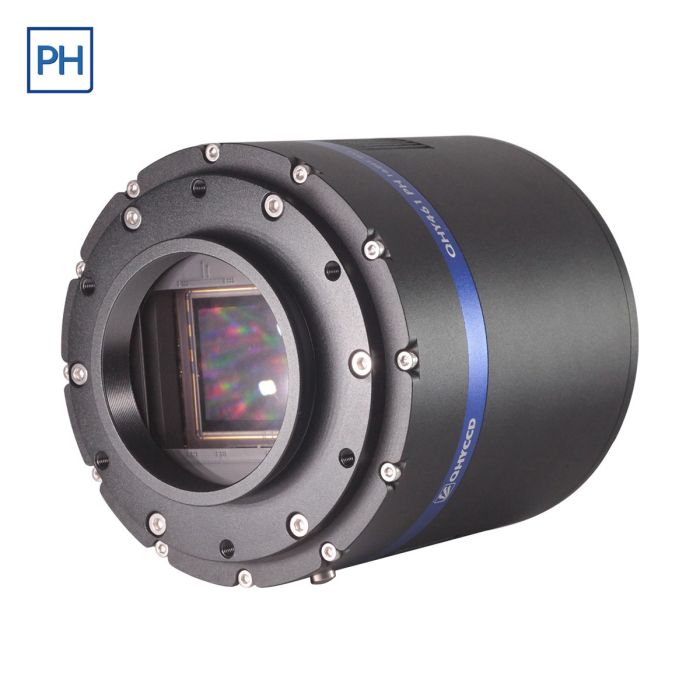
- This is a special order item.
- We will order it directly from the manufacturer and ship it to you as soon as it arrives at our warehouse.
- Transit time varies by location.
Stock count is accurate & shown in real time.
- This item is out of stock.
- Sign up for back-in-stock alerts to be notified when this item becomes available.
- This item is out of stock.
- We have no ETA from the manufacturer at this time.
- Sign up for back-in-stock alerts to be notified when this item becomes available.
Lower 48 States:
Orders over $50 ship free within the Lower 48 using a carrier and service we select based on your items and delivery location. Faster shipping options may be available at checkout.
U.S. Outside the Lower 48 (AK, HI, PR):
Free shipping on orders over $50 applies to many—but not all—items. Add items to your cart and enter your ZIP code to see available shipping options and any costs.
International Orders:
Free shipping does not apply to international orders. You’ll see available shipping options and costs during checkout. Some items can’t be shipped internationally due to size or manufacturer restrictions. Duties, taxes, brokerage fees, and tariffs are not included and are the customer’s responsibility.
1. Native 16 bit A/D
The new Sony sensor has native 16-bit A/D on-chip. The output is real 16-bits with 65536 levels. Compared to 12-bit and 14-bit A/D, a 16-bit A/D yields higher sample resolution and the system gain will be less than 1e-/ADU with no sample error noise and very low read noise.
2. BSI
One benefit of the back-illuminated CMOS structure is improved full well capacity. This is particularly helpful for sensors with small pixels. In a typical front-illuminated sensor, photons from the target entering the photosensitive layer of the sensor must first pass through the metal wiring that is embedded just above the photosensitive layer. The wiring structure reflects some of the photons and reduces the efficiency of the sensor. In the back- illuminated sensor the light is allowed to enter the photosensitive surface from the reverse side. In this case the sensor's embedded wiring structure is below the photosensitive layer. As a result, more incoming photons strike the photosensitive layer and more electrons are generated and captured in the pixel well. This ratio of photon to electron production is called quantum efficiency. The higher the quantum efficiency the more efficient the sensor is at converting photons to electrons and hence the more sensitive the sensor is to capturing an image of something dim.
3. Zero Amplify Glow
This is also a zero amplifer glow camera.
4. TRUE RAW Data
In the DSLR implementation there is a RAW image output, but typically it is not completely RAW. Some evidence of noise reduction and hot pixel removal is still visible on close inspection. This can have a negative effect on the image for astronomy such as the “star eater” effect. However, QHY Cameras offer TRUE RAW IMAGE OUTPUT and produces an image comprised of the original signal only, thereby maintaining the maximum flexibility for post-acquisition astronomical image processing programs and other scientific imaging applications.
5. Anti-Dew Technology
Based on almost 20-year cooled camera design experience, The QHY cooled camera has implemented the fully dew control solutions. The optic window has built-in dew heater and the chamber is protected from internal humidity condensation. An electric heating board for the chamber window can prevent the formation of dew and the sensor itself is kept dry with our silicon gel tube socket design for control of humidity within the sensor chamber.
6. Cooling
In addition to dual stage TE cooling, QHYCCD implements proprietary technology in hardware to control the dark current noise.
Advanced Functions
Multiple Read Modes
Multiple Readout Modes are special for QHY 16-bit Cameras (QHY600/268/461/411). Different readout modes have different driver timing, etc., and result in different performance. These readout modes are currently supported in the QHYCCD ASCOM Camera Driver, SharpCap and N.I.N.A.
- Readout Mode #0 (Photographic DSO Mode). This mode is suitable for most DSO imaging situations. In this mode you don't have to care about unity gain, because gain0 is good enough for a 16-bit sensor; however , there is a drop in the noise between Gain 25 and Gain 26.
- Readout Mode #1 (High Gain Mode). This mode is something like double native iso of some new digital cameras, whose danamic range can greatly incerase at the vary high iso value, like iso800, iso3200, etc. The high gain mode provide such improvement for QHYCCD 16bit cameras. We recommend you choose this mode when you have to capture at high gain, for example, a vary dark object. Please note the switch point of HGC/LGC of QHY600 is gain55, while QHY268/461 is 60. That means you must set the gain value a little larger than 55 or 60 under this mode to make the best of it.
- Readout Mode #2 (Extended Fullwell Mode). With a pixel size of 3.76um, these sensors already have an impressive full well capacity of 51ke. Nevertheless, QHYCCD has implemented a unique approach to achieve a full well capacity higher than 51ke- through innovative user controllable read mode settings. In Extended Fullwell Mode, the QHY600 can achieve an extremely large full-well charge value of nearly 80ke- and the QHY268 can achieve nearly 75ke-. Greater full-well capacity provides greater dynamic range and large variations in magnitude of brightness are less likely to saturate.
- Readout Mode #3 (Extended Fullwell Mode-2CMS). While Extended Fullwell Mode has large fullwell, it brings more noise, too. Don't worry, the 2CMS mode can reduce readout noise by about 1.3 times while keeping the same full well value and system gain as the #2 mode Extended Fullwell mode, by secondary sampling. We recommend this 2CMS mode more than mode #2 when you need larger fullwell.
Random change thermal noise suppression function
You may find some types of thermal noise can change with time in some back-illuminated CMOS cameras. This thermal noises has the characteristic of the fixed position of typical thermal noise, but the value is not related to the exposure time. Instead, each frame appears to have its own characteristics. The QHY600/268/461/411 use an innovative suppression technology that can significantly reduce the apparent level of such noise.
UVLO Protection
UVLO (Under Voltage Locking) is to protect the electronic device from damage caused by abnormally low voltages.
Our daily life experience tells us that the actual operational voltage of an electrical device must not significantly exceed the rated voltage, otherwise it will be damaged. For such precision equipment as cameras, long-term work at too low input voltage can also be detrimental to the working life of the camera, and may even make some devices, such as power manager, burn up due to long-term overload. In the all-in-one driver and SDK after 2021.10.23 stable version, the camera will give a warning when the input voltage of the camera is below 11V.
Optimizing USB Traffic to Minimize Horizontal Banding
It is common behavior for a CMOS sensor to contain some horizontal banding. Normally, random horizontal banding can be removed with multiple frame stacking so it does not affect the final image. However, periodic horizontal banding is not removed with stacking so it may appear in the final image. By adjust the USB traffic in Single Frame mode or Live Frame mode, you can adjust the frequency of the CMOS sensor driver and it can optimize the horizontal banding appeared on the image. This optimized is very effective to remove the periodic banding in some conditions.
A typical Periodic Horizontal Noise under certain USB_TRAFFIC values.

After Adjusting the USB Traffic to avoid the periodic horizontal noise.

Reboot the camera by power off and on
The camera is designed to use the +12V to reboot the camera without disconnecting and reconnecting the USB interface. This means that you can reboot the camera simply by shutting down the +12V and then powering it back on. This feature is very handy for remote controlling the camera in an observatory. You can use a remotely controlled power supply to reboot the camera. There is no need to consider how to reconnect the USB in the case of remote control.
Other Information
- Country of Manufacture: China
1. Native 16 bit A/D
The new Sony sensor has native 16-bit A/D on-chip. The output is real 16-bits with 65536 levels. Compared to 12-bit and 14-bit A/D, a 16-bit A/D yields higher sample resolution and the system gain will be less than 1e-/ADU with no sample error noise and very low read noise.
2. BSI
One benefit of the back-illuminated CMOS structure is improved full well capacity. This is particularly helpful for sensors with small pixels. In a typical front-illuminated sensor, photons from the target entering the photosensitive layer of the sensor must first pass through the metal wiring that is embedded just above the photosensitive layer. The wiring structure reflects some of the photons and reduces the efficiency of the sensor. In the back- illuminated sensor the light is allowed to enter the photosensitive surface from the reverse side. In this case the sensor's embedded wiring structure is below the photosensitive layer. As a result, more incoming photons strike the photosensitive layer and more electrons are generated and captured in the pixel well. This ratio of photon to electron production is called quantum efficiency. The higher the quantum efficiency the more efficient the sensor is at converting photons to electrons and hence the more sensitive the sensor is to capturing an image of something dim.
3. Zero Amplify Glow
This is also a zero amplifer glow camera.
4. TRUE RAW Data
In the DSLR implementation there is a RAW image output, but typically it is not completely RAW. Some evidence of noise reduction and hot pixel removal is still visible on close inspection. This can have a negative effect on the image for astronomy such as the “star eater” effect. However, QHY Cameras offer TRUE RAW IMAGE OUTPUT and produces an image comprised of the original signal only, thereby maintaining the maximum flexibility for post-acquisition astronomical image processing programs and other scientific imaging applications.
5. Anti-Dew Technology
Based on almost 20-year cooled camera design experience, The QHY cooled camera has implemented the fully dew control solutions. The optic window has built-in dew heater and the chamber is protected from internal humidity condensation. An electric heating board for the chamber window can prevent the formation of dew and the sensor itself is kept dry with our silicon gel tube socket design for control of humidity within the sensor chamber.
6. Cooling
In addition to dual stage TE cooling, QHYCCD implements proprietary technology in hardware to control the dark current noise.
Advanced Functions
Multiple Read Modes
Multiple Readout Modes are special for QHY 16-bit Cameras (QHY600/268/461/411). Different readout modes have different driver timing, etc., and result in different performance. These readout modes are currently supported in the QHYCCD ASCOM Camera Driver, SharpCap and N.I.N.A.
- Readout Mode #0 (Photographic DSO Mode). This mode is suitable for most DSO imaging situations. In this mode you don't have to care about unity gain, because gain0 is good enough for a 16-bit sensor; however , there is a drop in the noise between Gain 25 and Gain 26.
- Readout Mode #1 (High Gain Mode). This mode is something like double native iso of some new digital cameras, whose danamic range can greatly incerase at the vary high iso value, like iso800, iso3200, etc. The high gain mode provide such improvement for QHYCCD 16bit cameras. We recommend you choose this mode when you have to capture at high gain, for example, a vary dark object. Please note the switch point of HGC/LGC of QHY600 is gain55, while QHY268/461 is 60. That means you must set the gain value a little larger than 55 or 60 under this mode to make the best of it.
- Readout Mode #2 (Extended Fullwell Mode). With a pixel size of 3.76um, these sensors already have an impressive full well capacity of 51ke. Nevertheless, QHYCCD has implemented a unique approach to achieve a full well capacity higher than 51ke- through innovative user controllable read mode settings. In Extended Fullwell Mode, the QHY600 can achieve an extremely large full-well charge value of nearly 80ke- and the QHY268 can achieve nearly 75ke-. Greater full-well capacity provides greater dynamic range and large variations in magnitude of brightness are less likely to saturate.
- Readout Mode #3 (Extended Fullwell Mode-2CMS). While Extended Fullwell Mode has large fullwell, it brings more noise, too. Don't worry, the 2CMS mode can reduce readout noise by about 1.3 times while keeping the same full well value and system gain as the #2 mode Extended Fullwell mode, by secondary sampling. We recommend this 2CMS mode more than mode #2 when you need larger fullwell.
Random change thermal noise suppression function
You may find some types of thermal noise can change with time in some back-illuminated CMOS cameras. This thermal noises has the characteristic of the fixed position of typical thermal noise, but the value is not related to the exposure time. Instead, each frame appears to have its own characteristics. The QHY600/268/461/411 use an innovative suppression technology that can significantly reduce the apparent level of such noise.
UVLO Protection
UVLO (Under Voltage Locking) is to protect the electronic device from damage caused by abnormally low voltages.
Our daily life experience tells us that the actual operational voltage of an electrical device must not significantly exceed the rated voltage, otherwise it will be damaged. For such precision equipment as cameras, long-term work at too low input voltage can also be detrimental to the working life of the camera, and may even make some devices, such as power manager, burn up due to long-term overload. In the all-in-one driver and SDK after 2021.10.23 stable version, the camera will give a warning when the input voltage of the camera is below 11V.
Optimizing USB Traffic to Minimize Horizontal Banding
It is common behavior for a CMOS sensor to contain some horizontal banding. Normally, random horizontal banding can be removed with multiple frame stacking so it does not affect the final image. However, periodic horizontal banding is not removed with stacking so it may appear in the final image. By adjust the USB traffic in Single Frame mode or Live Frame mode, you can adjust the frequency of the CMOS sensor driver and it can optimize the horizontal banding appeared on the image. This optimized is very effective to remove the periodic banding in some conditions.
A typical Periodic Horizontal Noise under certain USB_TRAFFIC values.
After Adjusting the USB Traffic to avoid the periodic horizontal noise.
Reboot the camera by power off and on
The camera is designed to use the +12V to reboot the camera without disconnecting and reconnecting the USB interface. This means that you can reboot the camera simply by shutting down the +12V and then powering it back on. This feature is very handy for remote controlling the camera in an observatory. You can use a remotely controlled power supply to reboot the camera. There is no need to consider how to reconnect the USB in the case of remote control.
| Product Status | new |
|---|---|
| Free Shipping Graphic | Free US Shipping |
| Special Text Below Specs |
|
| Hide Found a better Shipped Price on Frontend? | No |
- Image Sensor: SONY IMX461 BSI CMOS Sensor
- Pixel Size: 3.76um x 3.76um
- Color / Mono Version: Mono Only
- Image Resolution: 11760 x 8896
- Effective Pixels: 102 Megapixels
- Effective Image Area: 44mm x 33mm
- Sensor Surface Glass: AR+AR Multi-Coating Clear Glass
- Full Well Capacity (1X1, 2X2, 3X3):
- 50ke- / 200ke- / 450ke- in Standard Mode
- 80ke- / 320ke- / 720ke- in Extend Full Well Mode
- A/D 16-bit (0-65535 greyscale) for 1X1Binning18bit in 2X2 19BIT in 3X3 20BIT in 4*4 software Binning
- Sensor Size: TYPICAL 3.4inch
- Read Noise: 1e to 3.7e (in HGC mode)
- Dark Current: Approx 0.003e/pixel/sec @ -20C
- Exposure Time: Range 50us - 3600sec
- Frame Rate:
- 2.7FPS @ 8BIT 1.3FPS@16BIT on USB3.0
- 2.7FPS @ 16BIT 6FPS @ 14BIT on 10Gigabit Fiber
- Shutter Type: Electric Rolling Shutter
- Computer Interface: USB3.0
- Filter Wheel Interface: 4PIN QHYCCD CFW Port
- Built-in Image Buffer: 1GByte DDR3 Buffer
- Cooling System: Dual Stage TEC cooler (-35C below ambient with air cooling).
- Anti-Dew Heater: Yes
- Telescope Interface: -
- Optic Window Type: AR+AR High Quality Multi-Layer Anti-Reflection Coating
- Back Focal Length: 32.5mm
1. Native 16 bit A/D
The new Sony sensor has native 16-bit A/D on-chip. The output is real 16-bits with 65536 levels. Compared to 12-bit and 14-bit A/D, a 16-bit A/D yields higher sample resolution and the system gain will be less than 1e-/ADU with no sample error noise and very low read noise.
2. BSI
One benefit of the back-illuminated CMOS structure is improved full well capacity. This is particularly helpful for sensors with small pixels. In a typical front-illuminated sensor, photons from the target entering the photosensitive layer of the sensor must first pass through the metal wiring that is embedded just above the photosensitive layer. The wiring structure reflects some of the photons and reduces the efficiency of the sensor. In the back- illuminated sensor the light is allowed to enter the photosensitive surface from the reverse side. In this case the sensor's embedded wiring structure is below the photosensitive layer. As a result, more incoming photons strike the photosensitive layer and more electrons are generated and captured in the pixel well. This ratio of photon to electron production is called quantum efficiency. The higher the quantum efficiency the more efficient the sensor is at converting photons to electrons and hence the more sensitive the sensor is to capturing an image of something dim.
3. Zero Amplify Glow
This is also a zero amplifer glow camera.
4. TRUE RAW Data
In the DSLR implementation there is a RAW image output, but typically it is not completely RAW. Some evidence of noise reduction and hot pixel removal is still visible on close inspection. This can have a negative effect on the image for astronomy such as the “star eater” effect. However, QHY Cameras offer TRUE RAW IMAGE OUTPUT and produces an image comprised of the original signal only, thereby maintaining the maximum flexibility for post-acquisition astronomical image processing programs and other scientific imaging applications.
5. Anti-Dew Technology
Based on almost 20-year cooled camera design experience, The QHY cooled camera has implemented the fully dew control solutions. The optic window has built-in dew heater and the chamber is protected from internal humidity condensation. An electric heating board for the chamber window can prevent the formation of dew and the sensor itself is kept dry with our silicon gel tube socket design for control of humidity within the sensor chamber.
6. Cooling
In addition to dual stage TE cooling, QHYCCD implements proprietary technology in hardware to control the dark current noise.
Advanced Functions
Multiple Read Modes
Multiple Readout Modes are special for QHY 16-bit Cameras (QHY600/268/461/411). Different readout modes have different driver timing, etc., and result in different performance. These readout modes are currently supported in the QHYCCD ASCOM Camera Driver, SharpCap and N.I.N.A.
- Readout Mode #0 (Photographic DSO Mode). This mode is suitable for most DSO imaging situations. In this mode you don't have to care about unity gain, because gain0 is good enough for a 16-bit sensor; however , there is a drop in the noise between Gain 25 and Gain 26.
- Readout Mode #1 (High Gain Mode). This mode is something like double native iso of some new digital cameras, whose danamic range can greatly incerase at the vary high iso value, like iso800, iso3200, etc. The high gain mode provide such improvement for QHYCCD 16bit cameras. We recommend you choose this mode when you have to capture at high gain, for example, a vary dark object. Please note the switch point of HGC/LGC of QHY600 is gain55, while QHY268/461 is 60. That means you must set the gain value a little larger than 55 or 60 under this mode to make the best of it.
- Readout Mode #2 (Extended Fullwell Mode). With a pixel size of 3.76um, these sensors already have an impressive full well capacity of 51ke. Nevertheless, QHYCCD has implemented a unique approach to achieve a full well capacity higher than 51ke- through innovative user controllable read mode settings. In Extended Fullwell Mode, the QHY600 can achieve an extremely large full-well charge value of nearly 80ke- and the QHY268 can achieve nearly 75ke-. Greater full-well capacity provides greater dynamic range and large variations in magnitude of brightness are less likely to saturate.
- Readout Mode #3 (Extended Fullwell Mode-2CMS). While Extended Fullwell Mode has large fullwell, it brings more noise, too. Don't worry, the 2CMS mode can reduce readout noise by about 1.3 times while keeping the same full well value and system gain as the #2 mode Extended Fullwell mode, by secondary sampling. We recommend this 2CMS mode more than mode #2 when you need larger fullwell.
Random change thermal noise suppression function
You may find some types of thermal noise can change with time in some back-illuminated CMOS cameras. This thermal noises has the characteristic of the fixed position of typical thermal noise, but the value is not related to the exposure time. Instead, each frame appears to have its own characteristics. The QHY600/268/461/411 use an innovative suppression technology that can significantly reduce the apparent level of such noise.
UVLO Protection
UVLO (Under Voltage Locking) is to protect the electronic device from damage caused by abnormally low voltages.
Our daily life experience tells us that the actual operational voltage of an electrical device must not significantly exceed the rated voltage, otherwise it will be damaged. For such precision equipment as cameras, long-term work at too low input voltage can also be detrimental to the working life of the camera, and may even make some devices, such as power manager, burn up due to long-term overload. In the all-in-one driver and SDK after 2021.10.23 stable version, the camera will give a warning when the input voltage of the camera is below 11V.
Optimizing USB Traffic to Minimize Horizontal Banding
It is common behavior for a CMOS sensor to contain some horizontal banding. Normally, random horizontal banding can be removed with multiple frame stacking so it does not affect the final image. However, periodic horizontal banding is not removed with stacking so it may appear in the final image. By adjust the USB traffic in Single Frame mode or Live Frame mode, you can adjust the frequency of the CMOS sensor driver and it can optimize the horizontal banding appeared on the image. This optimized is very effective to remove the periodic banding in some conditions.
A typical Periodic Horizontal Noise under certain USB_TRAFFIC values.
After Adjusting the USB Traffic to avoid the periodic horizontal noise.
Reboot the camera by power off and on
The camera is designed to use the +12V to reboot the camera without disconnecting and reconnecting the USB interface. This means that you can reboot the camera simply by shutting down the +12V and then powering it back on. This feature is very handy for remote controlling the camera in an observatory. You can use a remotely controlled power supply to reboot the camera. There is no need to consider how to reconnect the USB in the case of remote control.
Other Information
- Country of Manufacture: China
| Product Status | new |
|---|---|
| Free Shipping Graphic | Free US Shipping |
| Special Text Below Specs |
|
| Hide Found a better Shipped Price on Frontend? | No |
- Image Sensor: SONY IMX461 BSI CMOS Sensor
- Pixel Size: 3.76um x 3.76um
- Color / Mono Version: Mono Only
- Image Resolution: 11760 x 8896
- Effective Pixels: 102 Megapixels
- Effective Image Area: 44mm x 33mm
- Sensor Surface Glass: AR+AR Multi-Coating Clear Glass
- Full Well Capacity (1X1, 2X2, 3X3):
- 50ke- / 200ke- / 450ke- in Standard Mode
- 80ke- / 320ke- / 720ke- in Extend Full Well Mode
- A/D 16-bit (0-65535 greyscale) for 1X1Binning18bit in 2X2 19BIT in 3X3 20BIT in 4*4 software Binning
- Sensor Size: TYPICAL 3.4inch
- Read Noise: 1e to 3.7e (in HGC mode)
- Dark Current: Approx 0.003e/pixel/sec @ -20C
- Exposure Time: Range 50us - 3600sec
- Frame Rate:
- 2.7FPS @ 8BIT 1.3FPS@16BIT on USB3.0
- 2.7FPS @ 16BIT 6FPS @ 14BIT on 10Gigabit Fiber
- Shutter Type: Electric Rolling Shutter
- Computer Interface: USB3.0
- Filter Wheel Interface: 4PIN QHYCCD CFW Port
- Built-in Image Buffer: 1GByte DDR3 Buffer
- Cooling System: Dual Stage TEC cooler (-35C below ambient with air cooling).
- Anti-Dew Heater: Yes
- Telescope Interface: -
- Optic Window Type: AR+AR High Quality Multi-Layer Anti-Reflection Coating
- Back Focal Length: 32.5mm

QHY 461M-PH Cooled Monochrome Astronomy Camera