



















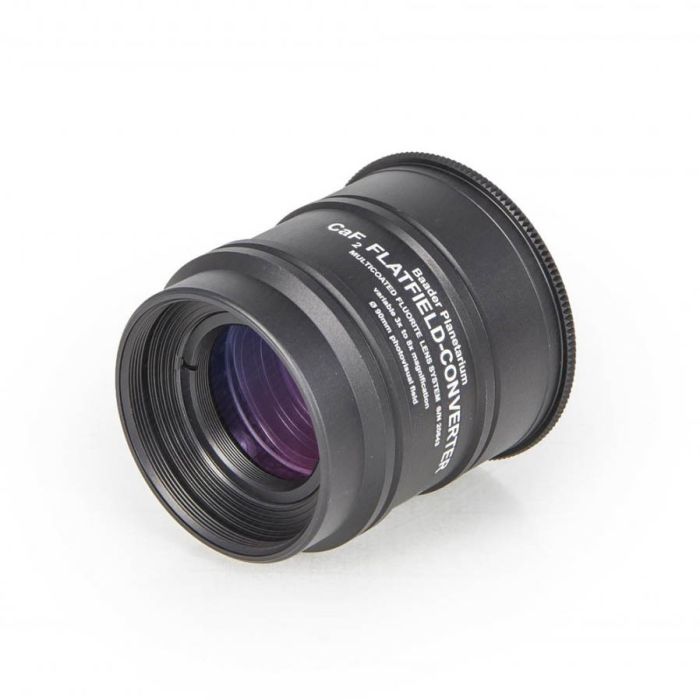
Baader 2" 3x-8x Fluorite Flatfield Converter/Barlow with M42x0.75 T/T2 Threads (FFC)
Stock count is accurate & shown in real time.
- This item is out of stock.
- Sign up for back-in-stock alerts to be notified when this item becomes available.
- This item is out of stock.
- We have no ETA from the manufacturer at this time.
- Sign up for back-in-stock alerts to be notified when this item becomes available.
Lower 48 States:
Orders over $50 ship free within the Lower 48 using a carrier and service we select based on your items and delivery location. Faster shipping options may be available at checkout.
U.S. Outside the Lower 48 (AK, HI, PR):
Free shipping on orders over $50 applies to many—but not all—items. Add items to your cart and enter your ZIP code to see available shipping options and any costs.
International Orders:
Free shipping does not apply to international orders. You’ll see available shipping options and costs during checkout. Some items can’t be shipped internationally due to size or manufacturer restrictions. Duties, taxes, brokerage fees, and tariffs are not included and are the customer’s responsibility.
HOW TO USE CAF2 OPTICAL SYSTEMS. FFC-WARNING ABOUT POSSIBLE LOSS OF WARRANTY:
The Baader-FFC contains lenses which are made of real Calziumfluorite-crystal. CaF2 has got an impressive refractivity which enables construction of the ultimate lens system that can deliver an incredible amount of sharpness across a very broad spectral range. No other barlow lens design can combine a similar sharpness with such a large image.
Unfortunately, such sophisticated optics are very sensitive to tension caused by temperature differences.
Under no circumstances must CaF2 be exposed to sudden or high changes in temperature. Do not use it for photographing the sun – the fast and high changes in temperature could destroy the Fluorit-lenses. Defects caused by thermal stress can be detected and measured here in house and are explicitly excluded from the warranty.
Also avoid fast changes in temperature during night-observation/imaging. Never use any Fluorite-lenses (especially not in the front lens of a telescope) at -20°C and then all of a sudden put it it into your living room at +20°C or more! In such a case, the resulting severe temperature stress just as well can be detected, when the lenses end up damaged.
Every CaF2 optic needs time to adapt to the surrounding temperature. To do so, for example bring the optical system into the outside in an insulated box and allow it to cool down inside that box over the time of an hour. Keep the box closed but outside. After the imaging session put the FFC back into the same box and allow it to gradually warm up inside that box while bringing it inside the house. Keep it there for at least one hour until you open the box and check that any moisture can dry out.
Please do not use the FFC, if you cannot supply the environment and time, to treat this high-end optical system in the way it demands.
- Apochromatic, multi-coated fluorite lens system
- 10-times higher line resolution than the world best projection eyepieces
- The FFC fits on every T-2 thread and in every 2" focuser
- Apochromatic, fully multi-coated lenses (note: w. multicoated Fluorite-lens faces)
- Resolution in lines is 10x higher than that of the best projection eyepieces
- 90 mm image circle for medium format cameras
For almost 20 years (as well as 20 years ago already) our customers had asked again and again: "Do you have a barlow lens or projection eyepiece – but with a flat field – which can be used with medium format (6x7 Pentax) cameras for imaging sun, moon and planets, but without the typical loss of sharpness?"
This bothered us back in those times, and finally one of the designers of the Zeiss APQ lenses calculated the ultimate projection system with a flat image field in 1997. To actually make this design become reality, extreme types of glasses were needed. In this case, two multicoated fluorit-lenses - at that time and until today - a nightmare to produce.
The result was an optical system with an unmatched sharpness, with a ten times higher resolution of line pairs than a Zeiss Abbe eyepiece. Even so the days of emulsion film cameras are long gone, this lens system has persisted to be "the sharpest barlow ever made".
By changing the distance to the camera sensor, you can vary the magnification between 3x and 8x. The optimum line resolution is set at 4x magnification, then you have the full sharpness over an image circle of 90 mm diameter. On the axis, the sharpness is only limited by your telescope – even at a magnification factor of 15x. We have tested this at an AstroPhysics lens telescope. Slowly slowly even the large diffraction limited field of 90 mm will become of importance again - with the advent of ultrafast and giant CMOS-cameras covering a field of 70 mm in diameter.
The FFC can be connected onto every M42x0.75 T-2 thread and its 2" main body diameter likewise fits into every 2" eyepiece clamp. With the help of our Astro T2-System and the M68-System you can connect it onto a whole world of telescopes.
For best results, you need to keep a certain distance to the original focus point. See the chart in the product photos above.
Other Information
- Country of Manufacture: Germany
- Baader Planetarium Warranty: Baader products are warranted for two years for flawless optical function (not necessarily cosmetic optical appearance).
- Apochromatic, fully multi-coated lenses (note: w. multicoated Fluorite-lens faces)
- Resolution in lines is 10x higher than that of the best projection eyepieces
- 90 mm image circle for medium format cameras
For almost 20 years (as well as 20 years ago already) our customers had asked again and again: "Do you have a barlow lens or projection eyepiece – but with a flat field – which can be used with medium format (6x7 Pentax) cameras for imaging sun, moon and planets, but without the typical loss of sharpness?"
This bothered us back in those times, and finally one of the designers of the Zeiss APQ lenses calculated the ultimate projection system with a flat image field in 1997. To actually make this design become reality, extreme types of glasses were needed. In this case, two multicoated fluorit-lenses - at that time and until today - a nightmare to produce.
The result was an optical system with an unmatched sharpness, with a ten times higher resolution of line pairs than a Zeiss Abbe eyepiece. Even so the days of emulsion film cameras are long gone, this lens system has persisted to be "the sharpest barlow ever made".
By changing the distance to the camera sensor, you can vary the magnification between 3x and 8x. The optimum line resolution is set at 4x magnification, then you have the full sharpness over an image circle of 90 mm diameter. On the axis, the sharpness is only limited by your telescope – even at a magnification factor of 15x. We have tested this at an AstroPhysics lens telescope. Slowly slowly even the large diffraction limited field of 90 mm will become of importance again - with the advent of ultrafast and giant CMOS-cameras covering a field of 70 mm in diameter.
The FFC can be connected onto every M42x0.75 T-2 thread and its 2" main body diameter likewise fits into every 2" eyepiece clamp. With the help of our Astro T2-System and the M68-System you can connect it onto a whole world of telescopes.
For best results, you need to keep a certain distance to the original focus point. See the chart in the product photos above.
HOW TO USE CAF2 OPTICAL SYSTEMS. FFC-WARNING ABOUT POSSIBLE LOSS OF WARRANTY:
The Baader-FFC contains lenses which are made of real Calziumfluorite-crystal. CaF2 has got an impressive refractivity which enables construction of the ultimate lens system that can deliver an incredible amount of sharpness across a very broad spectral range. No other barlow lens design can combine a similar sharpness with such a large image.
Unfortunately, such sophisticated optics are very sensitive to tension caused by temperature differences.
Under no circumstances must CaF2 be exposed to sudden or high changes in temperature. Do not use it for photographing the sun – the fast and high changes in temperature could destroy the Fluorit-lenses. Defects caused by thermal stress can be detected and measured here in house and are explicitly excluded from the warranty.
Also avoid fast changes in temperature during night-observation/imaging. Never use any Fluorite-lenses (especially not in the front lens of a telescope) at -20°C and then all of a sudden put it it into your living room at +20°C or more! In such a case, the resulting severe temperature stress just as well can be detected, when the lenses end up damaged.
Every CaF2 optic needs time to adapt to the surrounding temperature. To do so, for example bring the optical system into the outside in an insulated box and allow it to cool down inside that box over the time of an hour. Keep the box closed but outside. After the imaging session put the FFC back into the same box and allow it to gradually warm up inside that box while bringing it inside the house. Keep it there for at least one hour until you open the box and check that any moisture can dry out.
Please do not use the FFC, if you cannot supply the environment and time, to treat this high-end optical system in the way it demands.
- Apochromatic, multi-coated fluorite lens system
- 10-times higher line resolution than the world best projection eyepieces
- The FFC fits on every T-2 thread and in every 2" focuser
- Apochromatic, fully multi-coated lenses (note: w. multicoated Fluorite-lens faces)
- Resolution in lines is 10x higher than that of the best projection eyepieces
- 90 mm image circle for medium format cameras
For almost 20 years (as well as 20 years ago already) our customers had asked again and again: "Do you have a barlow lens or projection eyepiece – but with a flat field – which can be used with medium format (6x7 Pentax) cameras for imaging sun, moon and planets, but without the typical loss of sharpness?"
This bothered us back in those times, and finally one of the designers of the Zeiss APQ lenses calculated the ultimate projection system with a flat image field in 1997. To actually make this design become reality, extreme types of glasses were needed. In this case, two multicoated fluorit-lenses - at that time and until today - a nightmare to produce.
The result was an optical system with an unmatched sharpness, with a ten times higher resolution of line pairs than a Zeiss Abbe eyepiece. Even so the days of emulsion film cameras are long gone, this lens system has persisted to be "the sharpest barlow ever made".
By changing the distance to the camera sensor, you can vary the magnification between 3x and 8x. The optimum line resolution is set at 4x magnification, then you have the full sharpness over an image circle of 90 mm diameter. On the axis, the sharpness is only limited by your telescope – even at a magnification factor of 15x. We have tested this at an AstroPhysics lens telescope. Slowly slowly even the large diffraction limited field of 90 mm will become of importance again - with the advent of ultrafast and giant CMOS-cameras covering a field of 70 mm in diameter.
The FFC can be connected onto every M42x0.75 T-2 thread and its 2" main body diameter likewise fits into every 2" eyepiece clamp. With the help of our Astro T2-System and the M68-System you can connect it onto a whole world of telescopes.
For best results, you need to keep a certain distance to the original focus point. See the chart in the product photos above.
Other Information
- Country of Manufacture: Germany
- Baader Planetarium Warranty: Baader products are warranted for two years for flawless optical function (not necessarily cosmetic optical appearance).
| Product Status | new |
|---|---|
| Free Shipping Graphic | Free US Shipping |
| Hide Found a better Shipped Price on Frontend? | No |

Baader 2" 3x-8x Fluorite Flatfield Converter/Barlow with M42x0.75 T/T2 Threads (FFC)