



















Astronomik L-2 UV-IR Cut L-Filter - 1.25" Mounted

Stock count is accurate & shown in real time.
- This item is out of stock.
- Sign up for back-in-stock alerts to be notified when this item becomes available.
- This item is out of stock.
- We have no ETA from the manufacturer at this time.
- Sign up for back-in-stock alerts to be notified when this item becomes available.
Lower 48 States:
Orders over $50 ship free within the Lower 48 using a carrier and service we select based on your items and delivery location. Faster shipping options may be available at checkout.
U.S. Outside the Lower 48 (AK, HI, PR):
Free shipping on orders over $50 applies to many—but not all—items. Add items to your cart and enter your ZIP code to see available shipping options and any costs.
International Orders:
Free shipping does not apply to international orders. You’ll see available shipping options and costs during checkout. Some items can’t be shipped internationally due to size or manufacturer restrictions. Duties, taxes, brokerage fees, and tariffs are not included and are the customer’s responsibility.
Astronomik offers a range of three different ultraviolet (UV) and infrared (IR) blocking filters for the Luminance channel. These filters are designed to help you tune your setup to produce the sharpest, most contrast-rich images possible. The luminance channel is critical to a great final image because it provides the most signal, which means the filter should have the highest transmission possible with a wide spectral bandpass across the entire visible spectrum. This combination ensures the highest sensitivity and photon counts on your pixels.
However, not all optical instruments or additional optical elements like correctors, field-flatteners, or reducers have a perfect color correction. A Luminance filter with too wide a bandpass can show chromatic aberration of the optical system, resulting in soft or bloated stars and making image processing difficult. To address this, Astronomik offers its line of Luminance filters: the L-1 filter with the widest spectral window, the L-2 filter with a standard spectral window, and the L-3 filter with the narrowest spectral window.
Depending on the color errors of the instruments used, the Astronomik Luminance filter with the widest spectral window should be used.
- L-1 UV-IR Block filter:Ideal for chromatic aberration-free optical systems such as reflector telescopes, where additional lenses are only used to correct image errors, not to change the focal ratio.
- L-2 UV-IR Block filter:Suitable for APO refractors or very good doublets used with their native focal length, reflecting telescopes with focal reducers and RASA telescopes. The transmission is very close to the UV-IR blocking filters used by companies such as Canon and Nikon in their cameras.
- L-3 UV-IR Block filter:Designed for refractors and camera lenses with less-than-perfect color correction to minimize bluish halos around stars.
The transmission characteristics and coatings on the Astronomik Luminance filters are engineered to eliminate halos and reflections. Even with bright stars in the field of view, nebulae and galaxies are imaged with the finest structures and maximum contrast.
Additional note for photographers under light-polluted skies
The Astronomik CLS CCD filter is recommended as a replacement for the Astronomik Luminance filter. The Astronomik CLS CCD filter provides approximately the same amount of light in all three color channels while blocking nearly all unwanted light pollution, resulting in much deeper images with much less background noise from light-polluted observing sites.
Size of filter
Astronomik filters come in a wide range of standard sizes, both mounted and unmounted, to suit various optical setups and cameras.
This filter is a mounted filter in a threaded 1.25" cell (M28.5 x 0.6 thread).
Technical data
- Glass thickness: 1mm (except Astronomik OWB Type 3 and XT filters)
- Finely polished optical glass, free of any striae, residual stresses, and bubbles
- Extremely scratch-resistant and durable coating
- Completely resistant against high humidity and aging effects
- Astronomik MFR coating (Astronomik Deep-Sky RGB, UV-IR Block L-1, L-2, L-3, and Narrowband-Emissionline filters)
- Parfocal with other Astronomik filters
- Diffraction-limited
- Optimized spectral windows
- Delivered in a high-quality, long-lasting filter box
Due to the high-precision machining of the carrier substrate, all Astronomik filters are parfocal with wedge errors far below all common tolerances. Astronomik filters are diffraction-limited, ensuring that the optical performance (resolution and contrast) of your telescope is not compromised. Issues concerning focal distances and the exact alignment of images from each color channel are therefore effectively eliminated.
All Astronomik filters are ideal for modern cameras, including both CMOS- and CCD-based models, ensuring you capture the best possible images with your equipment. Sharpness, contrast, and the absence of any reflections and halos are guaranteed. Even with bright stars in the field of view, nebulae and galaxies will be captured with the finest structures. The Astronomik MFR coating is designed for optimal performance across a wide range of focal ratios of the optics used.
Every Astronomik filter undergoes a rigorous quality control process before delivery.
Useful Resources
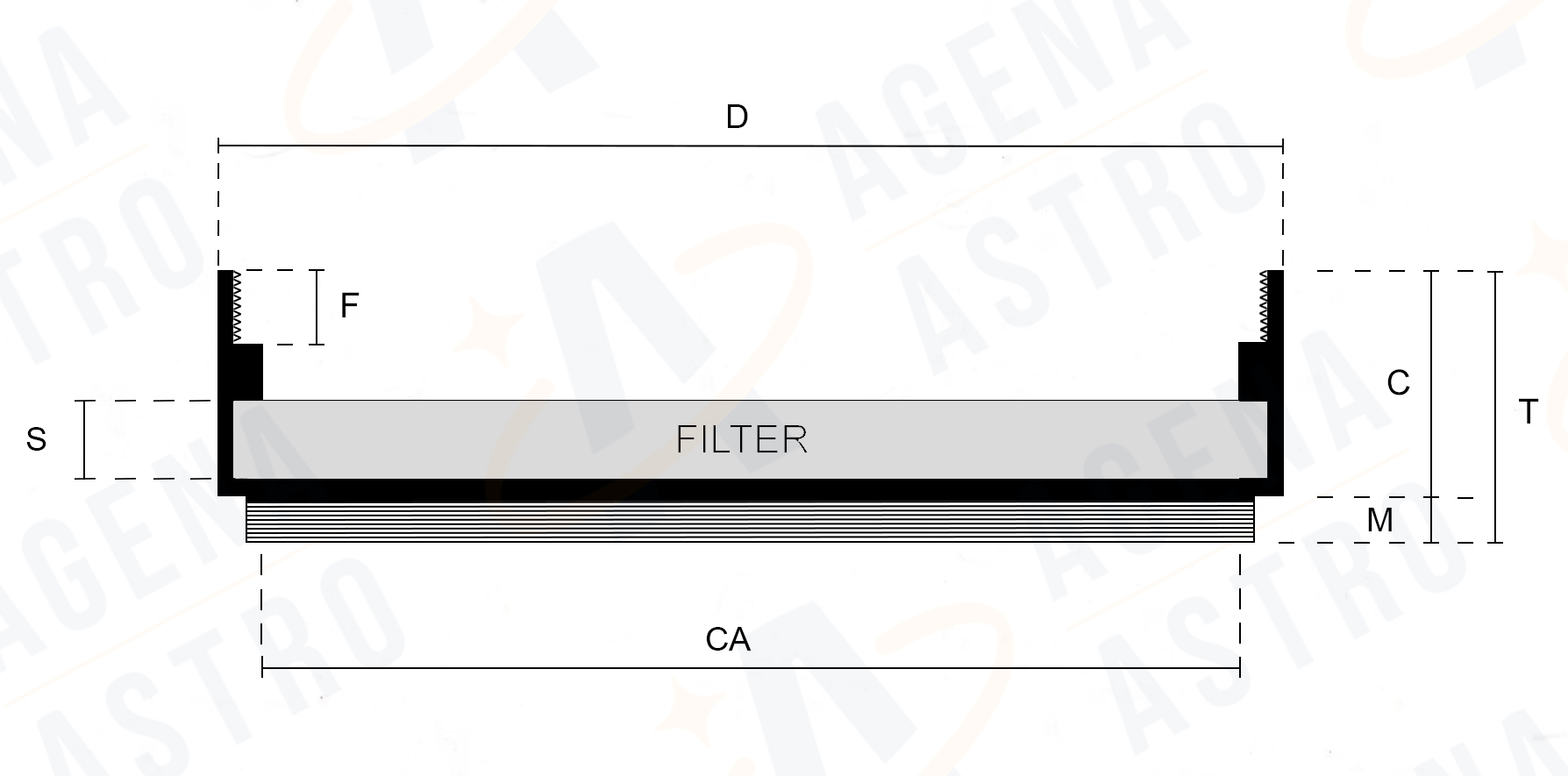
Filter Cell Specifications
D = Filter Cell Diameter = 31.2 mm / 1.23 in
T = Total Filter Height = 6.6 mm / 0.26 in
C = Filter Cell Height (Excluding Male Thread) = 4.5 mm / 0.18 in
M = Male Thread Length = 2.1 mm / 0.08 in
F = USABLE Female Filter Thread Length = Not threaded, so you cannot stack additional filters
S = Glass Substrate Thickness = 1 mm / 0.04 in
CA = Clear Aperture = 26.1 mm / 1.03 in
Other Information
- Country of Manufacture: Germany
Astronomik offers a range of three different ultraviolet (UV) and infrared (IR) blocking filters for the Luminance channel. These filters are designed to help you tune your setup to produce the sharpest, most contrast-rich images possible. The luminance channel is critical to a great final image because it provides the most signal, which means the filter should have the highest transmission possible with a wide spectral bandpass across the entire visible spectrum. This combination ensures the highest sensitivity and photon counts on your pixels.
However, not all optical instruments or additional optical elements like correctors, field-flatteners, or reducers have a perfect color correction. A Luminance filter with too wide a bandpass can show chromatic aberration of the optical system, resulting in soft or bloated stars and making image processing difficult. To address this, Astronomik offers its line of Luminance filters: the L-1 filter with the widest spectral window, the L-2 filter with a standard spectral window, and the L-3 filter with the narrowest spectral window.
Depending on the color errors of the instruments used, the Astronomik Luminance filter with the widest spectral window should be used.
- L-1 UV-IR Block filter:Ideal for chromatic aberration-free optical systems such as reflector telescopes, where additional lenses are only used to correct image errors, not to change the focal ratio.
- L-2 UV-IR Block filter:Suitable for APO refractors or very good doublets used with their native focal length, reflecting telescopes with focal reducers and RASA telescopes. The transmission is very close to the UV-IR blocking filters used by companies such as Canon and Nikon in their cameras.
- L-3 UV-IR Block filter:Designed for refractors and camera lenses with less-than-perfect color correction to minimize bluish halos around stars.
The transmission characteristics and coatings on the Astronomik Luminance filters are engineered to eliminate halos and reflections. Even with bright stars in the field of view, nebulae and galaxies are imaged with the finest structures and maximum contrast.
Additional note for photographers under light-polluted skies
The Astronomik CLS CCD filter is recommended as a replacement for the Astronomik Luminance filter. The Astronomik CLS CCD filter provides approximately the same amount of light in all three color channels while blocking nearly all unwanted light pollution, resulting in much deeper images with much less background noise from light-polluted observing sites.
Size of filter
Astronomik filters come in a wide range of standard sizes, both mounted and unmounted, to suit various optical setups and cameras.
This filter is a mounted filter in a threaded 1.25" cell (M28.5 x 0.6 thread).
Technical data
- Glass thickness: 1mm (except Astronomik OWB Type 3 and XT filters)
- Finely polished optical glass, free of any striae, residual stresses, and bubbles
- Extremely scratch-resistant and durable coating
- Completely resistant against high humidity and aging effects
- Astronomik MFR coating (Astronomik Deep-Sky RGB, UV-IR Block L-1, L-2, L-3, and Narrowband-Emissionline filters)
- Parfocal with other Astronomik filters
- Diffraction-limited
- Optimized spectral windows
- Delivered in a high-quality, long-lasting filter box
Due to the high-precision machining of the carrier substrate, all Astronomik filters are parfocal with wedge errors far below all common tolerances. Astronomik filters are diffraction-limited, ensuring that the optical performance (resolution and contrast) of your telescope is not compromised. Issues concerning focal distances and the exact alignment of images from each color channel are therefore effectively eliminated.
All Astronomik filters are ideal for modern cameras, including both CMOS- and CCD-based models, ensuring you capture the best possible images with your equipment. Sharpness, contrast, and the absence of any reflections and halos are guaranteed. Even with bright stars in the field of view, nebulae and galaxies will be captured with the finest structures. The Astronomik MFR coating is designed for optimal performance across a wide range of focal ratios of the optics used.
Every Astronomik filter undergoes a rigorous quality control process before delivery.
Astronomik offers a range of three different ultraviolet (UV) and infrared (IR) blocking filters for the Luminance channel. These filters are designed to help you tune your setup to produce the sharpest, most contrast-rich images possible. The luminance channel is critical to a great final image because it provides the most signal, which means the filter should have the highest transmission possible with a wide spectral bandpass across the entire visible spectrum. This combination ensures the highest sensitivity and photon counts on your pixels.
However, not all optical instruments or additional optical elements like correctors, field-flatteners, or reducers have a perfect color correction. A Luminance filter with too wide a bandpass can show chromatic aberration of the optical system, resulting in soft or bloated stars and making image processing difficult. To address this, Astronomik offers its line of Luminance filters: the L-1 filter with the widest spectral window, the L-2 filter with a standard spectral window, and the L-3 filter with the narrowest spectral window.
Depending on the color errors of the instruments used, the Astronomik Luminance filter with the widest spectral window should be used.
- L-1 UV-IR Block filter:Ideal for chromatic aberration-free optical systems such as reflector telescopes, where additional lenses are only used to correct image errors, not to change the focal ratio.
- L-2 UV-IR Block filter:Suitable for APO refractors or very good doublets used with their native focal length, reflecting telescopes with focal reducers and RASA telescopes. The transmission is very close to the UV-IR blocking filters used by companies such as Canon and Nikon in their cameras.
- L-3 UV-IR Block filter:Designed for refractors and camera lenses with less-than-perfect color correction to minimize bluish halos around stars.
The transmission characteristics and coatings on the Astronomik Luminance filters are engineered to eliminate halos and reflections. Even with bright stars in the field of view, nebulae and galaxies are imaged with the finest structures and maximum contrast.
Additional note for photographers under light-polluted skies
The Astronomik CLS CCD filter is recommended as a replacement for the Astronomik Luminance filter. The Astronomik CLS CCD filter provides approximately the same amount of light in all three color channels while blocking nearly all unwanted light pollution, resulting in much deeper images with much less background noise from light-polluted observing sites.
Size of filter
Astronomik filters come in a wide range of standard sizes, both mounted and unmounted, to suit various optical setups and cameras.
This filter is a mounted filter in a threaded 1.25" cell (M28.5 x 0.6 thread).
Technical data
- Glass thickness: 1mm (except Astronomik OWB Type 3 and XT filters)
- Finely polished optical glass, free of any striae, residual stresses, and bubbles
- Extremely scratch-resistant and durable coating
- Completely resistant against high humidity and aging effects
- Astronomik MFR coating (Astronomik Deep-Sky RGB, UV-IR Block L-1, L-2, L-3, and Narrowband-Emissionline filters)
- Parfocal with other Astronomik filters
- Diffraction-limited
- Optimized spectral windows
- Delivered in a high-quality, long-lasting filter box
Due to the high-precision machining of the carrier substrate, all Astronomik filters are parfocal with wedge errors far below all common tolerances. Astronomik filters are diffraction-limited, ensuring that the optical performance (resolution and contrast) of your telescope is not compromised. Issues concerning focal distances and the exact alignment of images from each color channel are therefore effectively eliminated.
All Astronomik filters are ideal for modern cameras, including both CMOS- and CCD-based models, ensuring you capture the best possible images with your equipment. Sharpness, contrast, and the absence of any reflections and halos are guaranteed. Even with bright stars in the field of view, nebulae and galaxies will be captured with the finest structures. The Astronomik MFR coating is designed for optimal performance across a wide range of focal ratios of the optics used.
Every Astronomik filter undergoes a rigorous quality control process before delivery.
Useful Resources
Filter Cell Specifications
D = Filter Cell Diameter = 31.2 mm / 1.23 in
T = Total Filter Height = 6.6 mm / 0.26 in
C = Filter Cell Height (Excluding Male Thread) = 4.5 mm / 0.18 in
M = Male Thread Length = 2.1 mm / 0.08 in
F = USABLE Female Filter Thread Length = Not threaded, so you cannot stack additional filters
S = Glass Substrate Thickness = 1 mm / 0.04 in
CA = Clear Aperture = 26.1 mm / 1.03 in
Other Information
- Country of Manufacture: Germany
| Product Status | new |
|---|---|
| Free Shipping Graphic | Free US Shipping |
| Hide Found a better Shipped Price on Frontend? | No |

Astronomik L-2 UV-IR Cut L-Filter - 1.25" Mounted